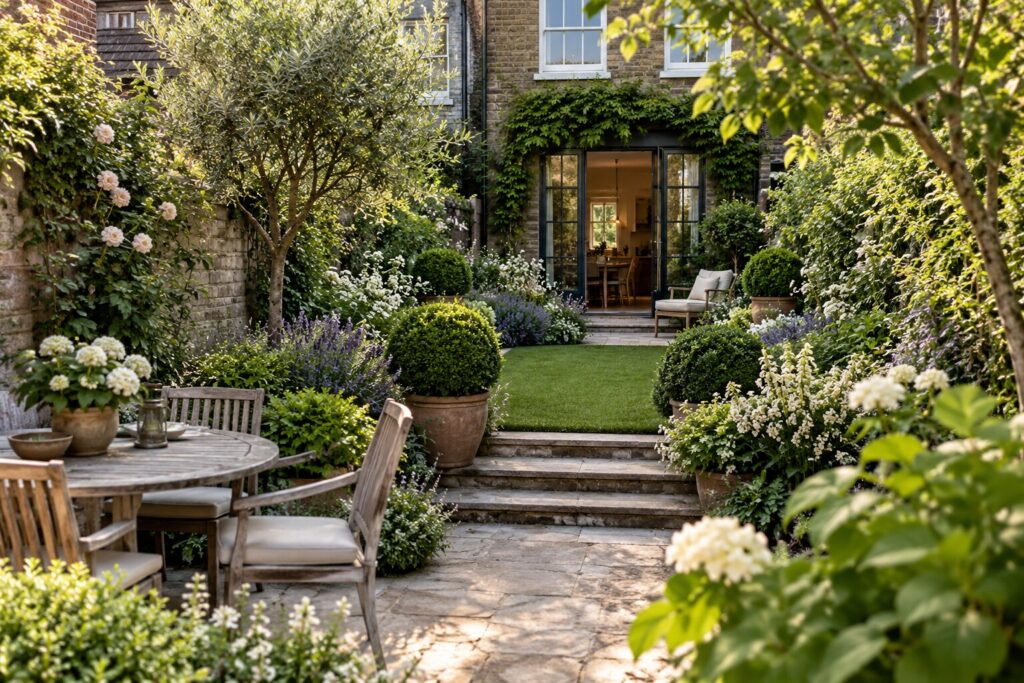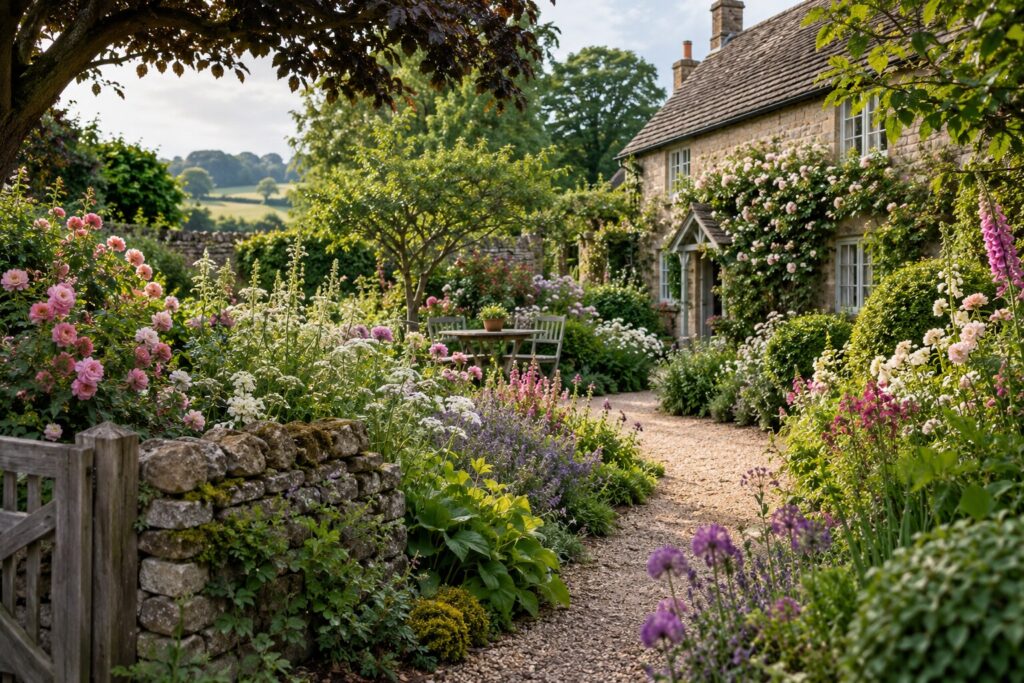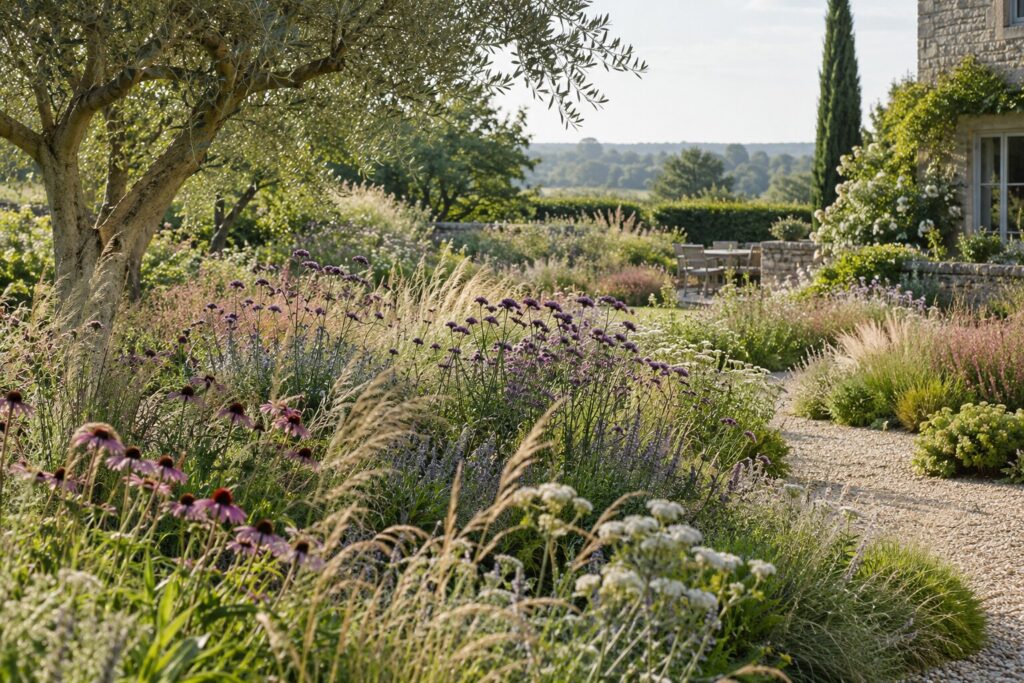
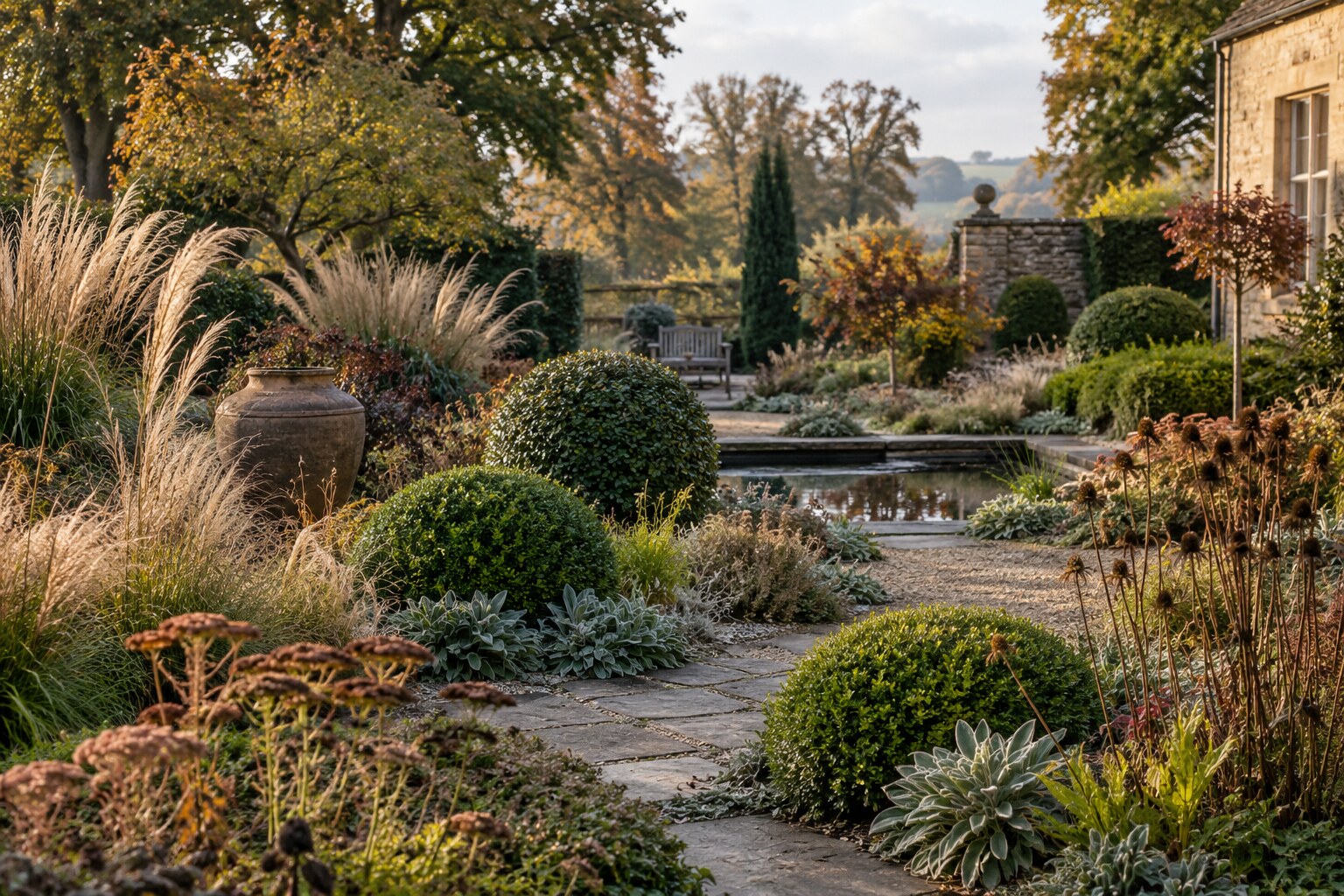
A garden with year-round interest is not a garden that flowers continuously. Trying to force twelve months of bloom often creates an unnecessarily complicated planting scheme. A more convincing garden uses structure, foliage, bark, stems, seedheads, seasonal colour and carefully timed flowers so that there is always something worth noticing.
Start with what remains
Trees, hedges, shrubs, walls, paths and other permanent elements form the garden’s underlying composition. They are particularly important between late autumn and early spring, when many herbaceous plants have disappeared.
A garden does not need to be dominated by evergreen plants, but a few well-positioned permanent shapes can prevent it from feeling empty in winter.
Think in seasonal layers
Instead of asking what flowers all year, ask what carries each part of the year. Bulbs and fresh foliage may dominate early spring. Flowering shrubs and perennials can build through late spring and summer. Later perennials, berries, grasses and autumn foliage then take over.
The garden does not need to peak everywhere at once. In fact, it is usually more interesting when different areas become important at different times.
Use foliage as part of the design
Leaves are present for much longer than most flowers. Their size, colour and shape therefore have an enormous influence on the character of a border. Broad leaves beside fine grasses, dark green beside silver or fresh lime green, and glossy foliage beside softer textures can create interest without relying on bloom.
Let the garden age into autumn
Some of the strongest late-season gardens are those where plants are allowed to change visibly. Seedheads, dry stems and fading grasses can continue to contribute structure. Low autumn light often makes these forms more beautiful rather than less.
This does not mean leaving everything untouched. Remove material that has collapsed unpleasantly or is diseased, but consider whether a standing stem still contributes before cutting it down.
See What to do with fallen leaves for a similarly selective approach to autumn clearing.
Use winter to read the garden
Winter is one of the best times to judge the structure of a garden. With fewer flowers competing for attention, paths, boundaries, trees and open space become much clearer. Weak areas also reveal themselves.
If the garden looks completely empty from December to February, the answer may not be more flowers. It may need a stronger shrub, a small tree, a hedge or simply a better-defined path.
Photograph the garden through the year
Memory tends to favour the garden at its best. Taking a photograph from the same position every month gives a much more useful record. It quickly shows where long gaps occur and prevents unnecessary additions to areas that are already performing well.
Fill genuine gaps slowly
Year-round interest is usually built over several seasons. Observe first, then introduce plants or structure where there is a clear need. A single well-chosen addition can sometimes transform an entire period of the year.
Continue with Planting a garden for the seasons, Planting bulbs for spring and Preparing the garden for winter.