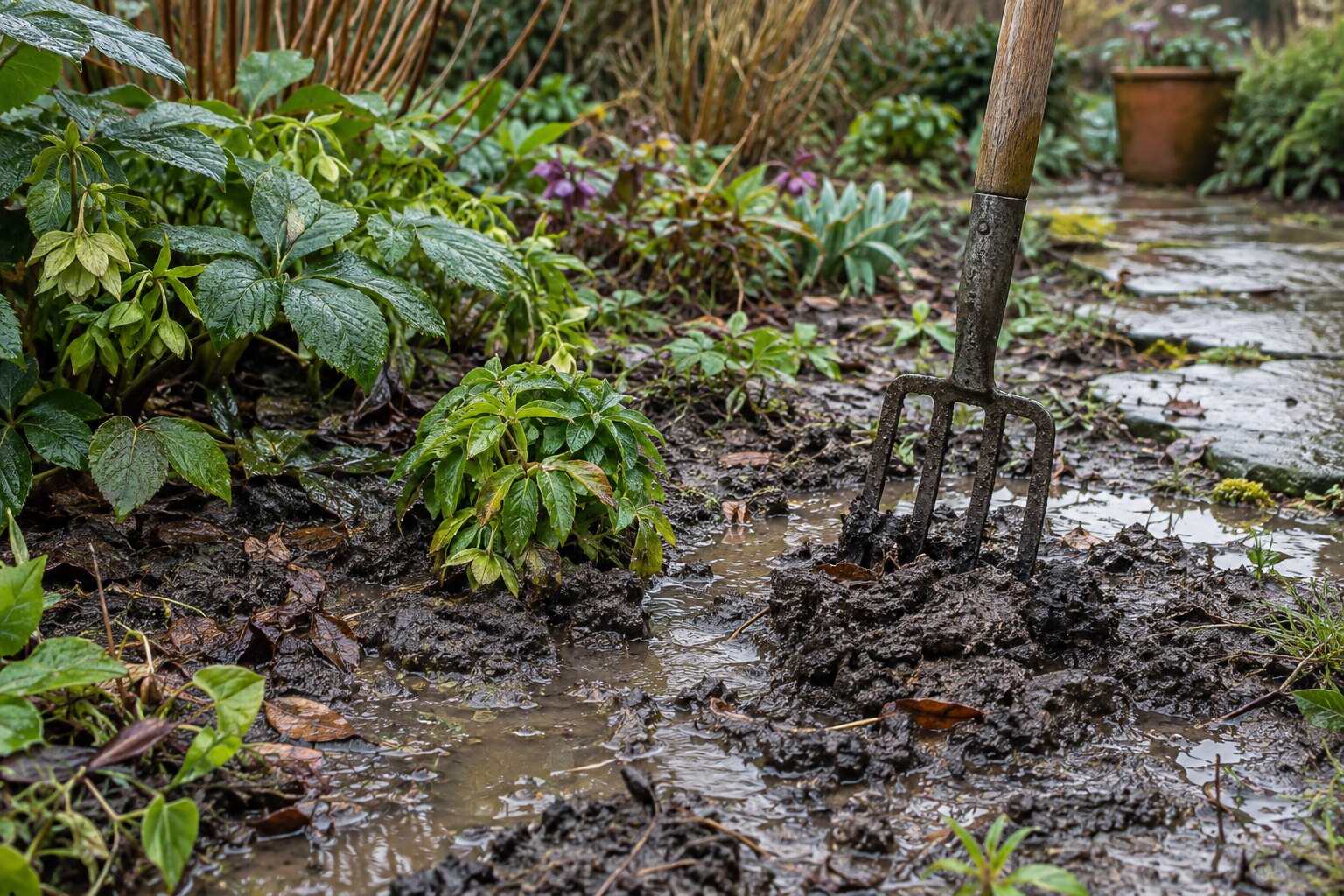
Waterlogged soil is more than simply wet soil. When water fills most of the spaces that normally hold air, plant roots can struggle to breathe. If the condition persists, roots weaken or die and plants may become yellow, stunted or unstable.
The correct solution depends on why the water is present. Heavy soil, compaction, a high water table, a low point in the garden and runoff from surrounding surfaces can all produce similar symptoms.
Do not start digging while the soil is saturated
Walking and digging on saturated soil can cause severe compaction and smear the sides of planting holes. This is especially damaging on clay.
If possible, keep off the affected area until some water has drained and the soil is workable again.
Work out where the water comes from
Observe the garden during and after heavy rain. Does water collect in one hollow? Does it run from a paved area or neighbouring higher ground? Is the entire garden saturated or only one bed?
Understanding the source prevents you from installing a solution in the wrong place.
Check for compaction
Construction work, repeated foot traffic and machinery can create compacted layers that slow drainage dramatically.
Once conditions are suitable, test the soil with a fork or spade. If penetration becomes suddenly difficult at a consistent depth, a compacted layer may be part of the problem.
Improve soil structure gradually
Organic matter can improve the structure of heavy soils over time. Mulching with suitable compost or leaf mould encourages biological activity and better aggregation.
Do not expect one application to transform a persistently wet site. Soil improvement is cumulative.
Avoid creating a planting sump
On heavy soil, a deep planting hole filled with very free-draining compost can behave like a bucket surrounded by less permeable ground. Water may collect around the roots rather than disappear.
Improve a wider area where possible and keep the planting medium reasonably compatible with the surrounding soil.
Raised beds can help in the right place
Raising the root zone above persistently saturated ground can improve conditions for plants that need better drainage. This is particularly useful in kitchen gardens and defined planting areas.
A raised bed does not remove the underlying water, so it should not block natural drainage or send water towards buildings or neighbouring land.
Choose plants that tolerate the conditions
If a site is naturally moisture-retentive, working with the conditions can be more successful than trying to make every part of the garden dry.
Many plants tolerate moist soils well, while others require sharp drainage. Match the plant to the site rather than repeatedly replacing plants that dislike the conditions.
When drainage work may be necessary
Where waterlogging is severe, persistent and caused by site drainage rather than soil structure alone, professional drainage advice may be appropriate.
Any drain needs a legitimate outlet. Moving water from one part of the garden only to create a problem elsewhere is not a solution.
Protect vulnerable plants during a wet winter
Plants in the worst positions may need lifting or moving if their roots are clearly at risk. Container plants should have unobstructed drainage holes and should not sit in permanently full saucers outdoors.
Signs of root stress
- Leaves yellow despite the soil being wet.
- Plants wilt even though water is present.
- Growth becomes weak and stunted.
- Roots are dark, soft or decaying.
- Plants become loose because roots have died.
Waterlogging is a site problem first
The most durable solution comes from understanding the movement of water through the garden. Improve compacted soil, protect structure, use organic matter, adapt planting and install drainage only where there is a clear reason and a safe outlet.
For soil improvement, read A simple guide to garden compost and Peat-free compost in the garden. For winter conditions, see Preparing the garden for winter.