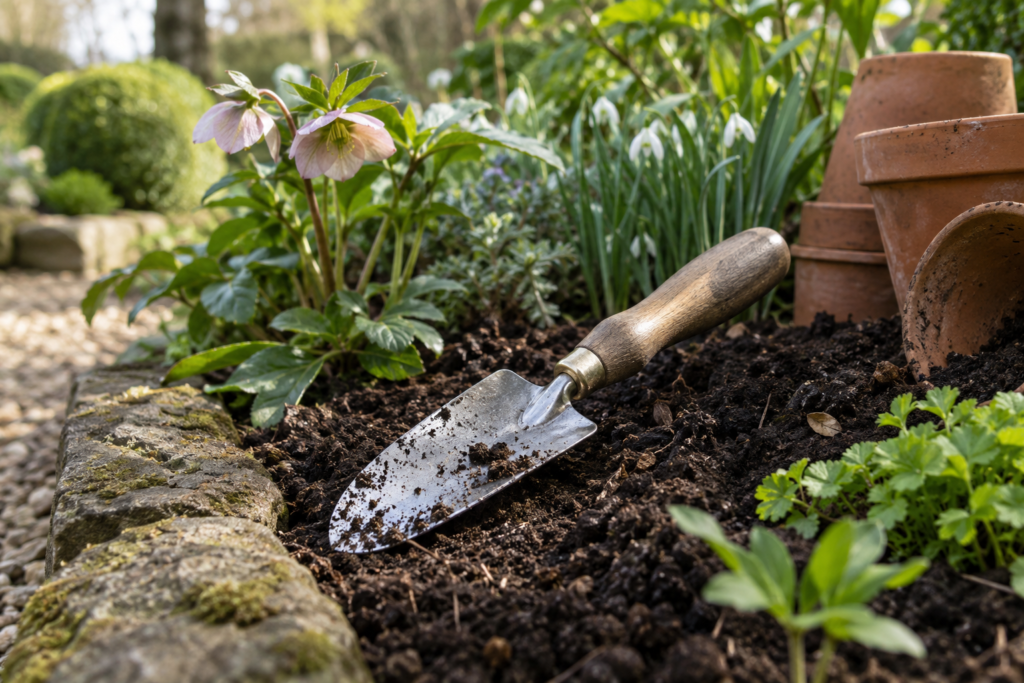
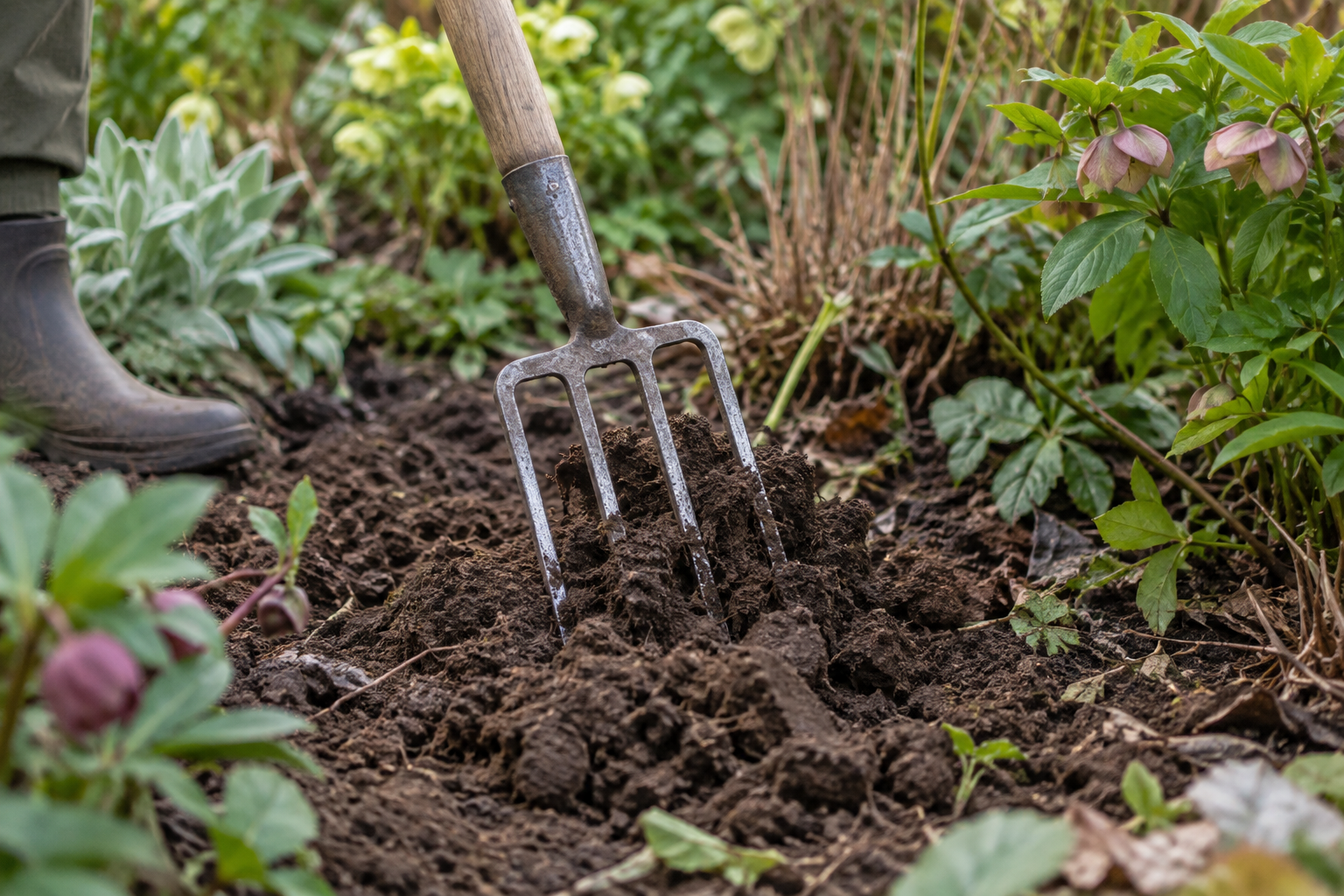
A garden fork is often treated as a rough digging tool, but its real strength is that it can loosen soil with less cutting and turning than a spade. Used well, it is useful for lifting plants, breaking compacted ground, aerating soil and moving organic material.
The important part is working with the tines rather than using the handle as a lever beyond what the tool can safely tolerate.
Garden fork or border fork?
A full-sized garden fork is suited to larger areas and heavier work. A border fork is smaller and easier to control between established plants.
If you mainly work in densely planted borders, the smaller tool may be more useful than a large fork that damages neighbouring roots and foliage simply because there is not enough room to use it properly.
Use your weight, not only your arms
Place the tines where you want them to enter the soil and use your foot on the tread where the fork provides one. Keep your body balanced and let your weight help push the fork into the ground.
Repeatedly forcing a fork into resistant ground using only your arms is tiring and increases the temptation to twist the handle excessively.
Loosening soil without turning it completely
Insert the tines vertically, then draw the handle back slightly to create cracks and air spaces. Move a short distance and repeat.
This can loosen compacted ground without completely inverting the soil profile.
Do not work saturated soil
Forking very wet clay can do more harm than good. The soil smears and compacts, and foot traffic damages its structure.
Wait until the ground is moist but workable rather than sticky enough to cling heavily to tools.
Lifting established plants
A fork is particularly useful when lifting perennials because the tines can move through soil with less cutting than a spade blade.
Begin outside the main crown and work around the plant gradually. Loosen the root ball from several sides rather than trying to lever the whole plant out from one position.
Use two forks for dividing some perennials
Dense clumps can sometimes be separated with two forks inserted back-to-back into the root mass. Push the handles towards each other so the tines move apart and separate the plant.
This works best with suitable fibrous-rooted perennials. It is not appropriate for every plant.
Aerating compacted areas
On a small lawn, a garden fork can create aeration holes in heavily trafficked areas. Push the tines into the soil at regular intervals and gently ease them back.
For large lawns or very severe compaction, specialist aeration equipment is more efficient.
Moving compost and mulch
A fork is often better than a spade for moving coarse compost, manure and fibrous mulch because the tines enter the material easily.
Choose the correct fork for the job: a broad manure or compost fork is more efficient for loose material than a narrow digging fork.
Avoid excessive levering
If the tines are buried beneath a large stone or thick root, forcing the handle backwards can bend tines or damage the shaft.
Reposition the fork, loosen the surrounding soil and use an appropriate tool for the obstruction.
Keep the tines clean
Soil left packed between the tines holds moisture against the metal. Brush or wash the fork clean after heavy use and let it dry before storage.
The fork is a soil-reading tool
Used slowly, a garden fork tells you a great deal about the ground. You feel compacted layers, roots, stones and changes in soil structure through the handle. That feedback helps you work more carefully than simply forcing a blade through everything in the way.
For improving difficult ground, see A simple guide to garden compost. For tool maintenance, read Keeping garden tools in good condition.