
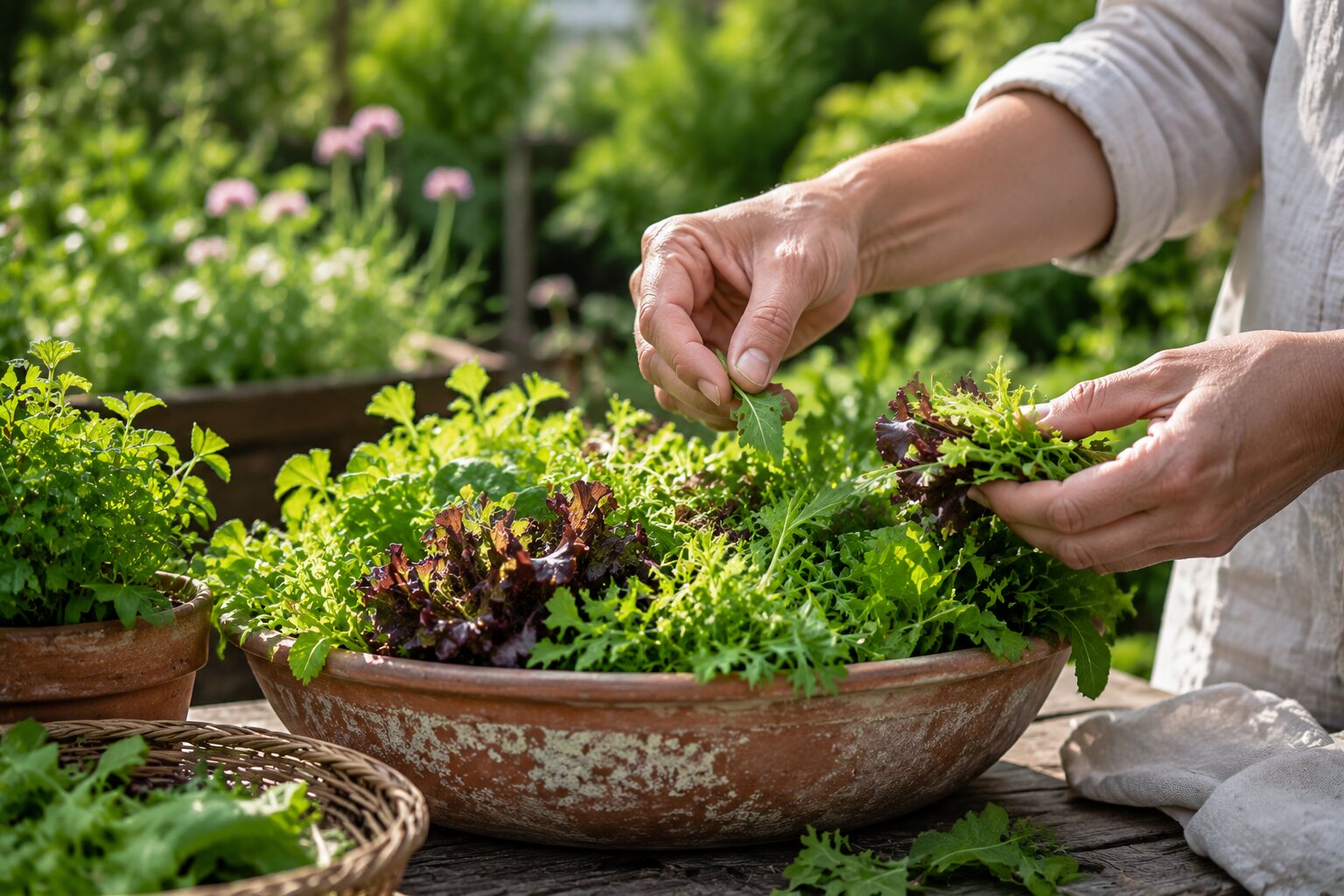
Salad leaves are among the most useful crops for container growing. They need relatively little space, grow quickly and can be harvested over a long period if sowings are staggered. A pot close to the kitchen can also be more convenient than a larger vegetable bed for something harvested in small amounts several times a week.
The main challenge is consistency. Salad leaves grow best when they are not repeatedly stressed by drying out, overcrowding or excessive heat.
Choose leaves for the season
Loose-leaf lettuces, rocket, mizuna, mustard leaves and mixed baby-leaf seed are all suitable for containers, but they do not behave identically. Some tolerate cool conditions well, while others become more peppery or bolt quickly in hot weather.
Rather than sowing one large container for the whole year, use smaller repeated sowings and adjust the varieties to the season.
The container matters less than the drainage
Window boxes, troughs and ordinary pots can all work. The container should be deep enough to hold a useful volume of compost and must have open drainage holes. Very shallow pots dry rapidly and leave little margin for error during warm weather.
Larger containers are generally easier to keep evenly moist than very small ones.
Use fresh peat-free compost
Fill the container with a good-quality peat-free multipurpose compost. Leave a small watering space below the rim so that water can soak in rather than immediately running over the edge.
Old exhausted compost from a previous heavily fed crop is less predictable. Where compost is reused, understand what grew in it before and refresh or amend it appropriately.
1. Sow thinly
Dense sowing may create an impressive green surface initially, but overcrowded seedlings compete quickly. Scatter seed as evenly as possible or sow in short rows if that makes thinning and harvesting easier.
Cover the seed according to packet instructions, then water gently so the seed remains where you put it.
2. Keep the compost evenly moist
Young salad leaves have shallow root systems. Containers can dry much faster than garden soil, especially in wind or sun. Check the compost with your fingers rather than judging only from the surface colour.
Water thoroughly when needed, allowing excess water to drain. Constantly saturated compost is no better than repeatedly dry compost.
3. Thin before plants compete badly
For baby leaves, plants can remain relatively close, but even then they need enough airflow and root space to grow cleanly. Thinnings from many edible crops can be used as a small first harvest if they are suitable to eat.
4. Harvest little and often
For cut-and-come-again crops, take outer leaves or cut above the growing point so the plant can produce again. Do not remove every leaf from a weak young plant. Frequent moderate harvesting usually keeps the container productive for longer.
Make succession sowing the default
The simplest way to avoid a sudden glut followed by an empty pot is to sow another small batch every few weeks during suitable growing conditions. Keep two or three containers at different stages rather than expecting one sowing to remain perfect indefinitely.
Summer needs a different approach
Very hot containers dry quickly and many salad plants respond to heat and stress by bolting. During summer, move pots away from the hottest reflected heat where practical and provide reliable moisture. Afternoon shade can be useful for crops that struggle in intense heat.
Choose varieties described as suitable for warmer conditions and harvest regularly rather than leaving plants to become old and coarse.
Cool-season salads
Late-summer and early-autumn sowings can extend the season considerably, especially where containers can be moved to a sheltered position. Growth slows as light levels fall, so crops sown too late may remain small for a long period.
A cold frame or unheated greenhouse can offer useful protection, but ventilation remains important during mild weather.
Watch for common problems
- Leaves wilt repeatedly: the container may be too small or drying too quickly.
- Plants bolt rapidly: heat, drought stress or simply maturity may be the cause.
- Seedlings disappear: inspect for slugs and snails, especially around pots at ground level.
- Growth is pale and weak: overcrowding, exhausted compost or poor light may be limiting growth.
- Leaves become very peppery: some crops naturally intensify with age, heat and dry conditions.
Keep the system simple
Container salads work best as a routine rather than a single project: sow a little, water consistently, harvest frequently and start the next pot before the current one is finished. With a few containers in rotation, even a small terrace or doorstep can provide useful fresh leaves for much of the growing season.
Continue with Growing herbs close to the kitchen, Growing vegetables at home and Why raised beds remain useful.