Plant supports work best when you hardly notice them. Tall perennials can collapse after wind and rain, but heavy staking added after stems have already fallen often leaves a border looking tied together rather than naturally supported.
The most effective technique is usually to provide support early, while stems are still growing through and around it.
Which plants need support?
Not every tall perennial needs staking. Plants growing in rich soil or partial shade may become taller and softer than the same variety in leaner, sunnier conditions.
Repeatedly collapsing plants, large heavy flower heads and exposed positions are useful signs that support may help.
Support early
Install supports while plants are still relatively short. As the stems grow, foliage hides the structure and the support becomes integrated into the plant.
Waiting until flowering stems have fallen usually requires taller stakes and visible ties.
Use twiggy branches for informal support
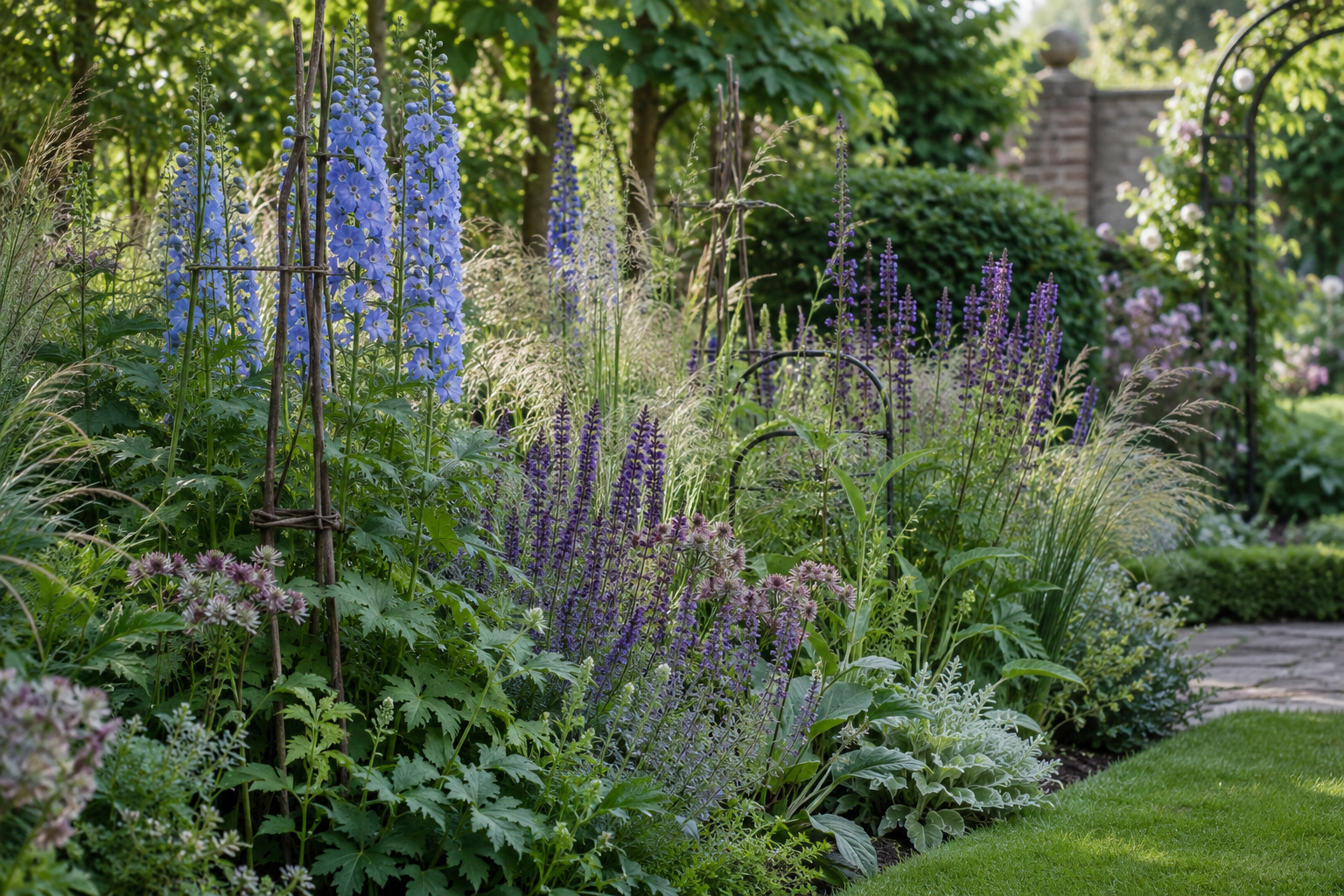
Branched prunings pushed into the soil around an emerging clump create a natural network through which stems can grow.
This traditional method is particularly effective in informal planting because the support almost disappears once foliage develops.
Metal grow-through supports
Grid or ring supports positioned over a young plant allow stems to emerge through separate openings. They are useful for large clump-forming perennials and plants with multiple flowering stems.
Choose a support that will finish below the mature flower heads so the plant remains visually dominant.
Individual stakes
A single tall stem may need its own stake. Position the stake close enough to support the stem without driving it directly through the main crown or root system.
Tie the stem loosely enough to allow some natural movement and thickening.
Use soft ties
Wire and very thin string can cut into growing stems. Use soft garden twine or flexible ties that spread pressure over a wider area.
Check ties later in the season because stems may expand considerably.
Do not pull every stem into a tight bundle
A common mistake is to tie a wide clump tightly to one central stake. This changes the natural shape of the plant and creates an obvious narrow waist.
Several discreet supports around the clump usually produce a more natural outline.
Consider neighbouring plants
Dense surrounding planting can provide a degree of natural support. Strong neighbouring perennials and shrubs break the wind and help stems remain upright.
This is one reason layered planting often needs less obvious staking than isolated specimen plants.
Reduce the need for staking
Plants become more prone to collapse when grown in excessive shade or very rich conditions. If a perennial repeatedly becomes taller than expected, check whether its position suits it.
A plant that needs a complex framework every year may simply be in the wrong place.
The Chelsea chop
Some late-flowering perennials can be cut back partially in late spring to produce shorter, bushier growth and later flowers. This technique is often known as the Chelsea chop.
It is not suitable for every perennial. Check the response of the particular plant before cutting valuable growth.
Remove supports at the end of the season
Once plants are cut down or have collapsed naturally, collect reusable supports, clean them where necessary and store them dry.
Leaving metal grids hidden in bare borders can create a trip hazard during winter work.
Good staking preserves the plant’s character
The aim is not to make every stem perfectly vertical. A good support prevents destructive collapse while allowing enough movement for the plant to retain its natural form.
For border structure, read Planting a garden for the seasons. For summer tools, see A few useful tools for summer gardening.