
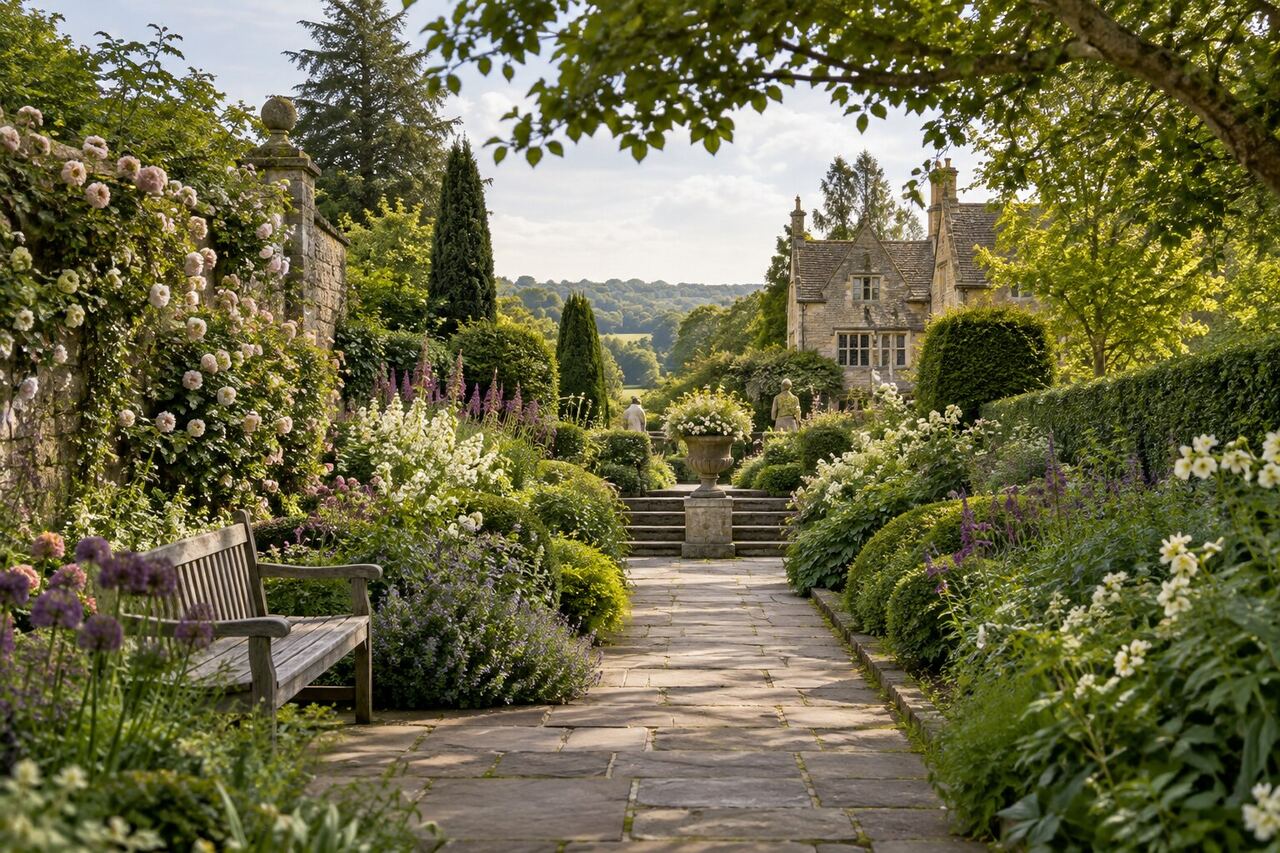
Visiting a great garden is one of the most useful ways to learn about garden design. Photographs can show a beautiful border or a memorable view, but walking through a garden reveals something more important: sequence. You experience what is hidden and revealed, where a path slows you down, how planting changes around a corner and how architecture, landscape and plants work together.
The most useful visits are therefore not only about collecting plant names. They are opportunities to understand why a garden feels the way it does.
Look before you photograph
When you first arrive in an important garden, resist the temptation to record every detail immediately. Look at the whole scene. What is your eye drawn towards? What establishes the character: a long lawn, a clipped hedge, mature trees, architecture or dense planting?
That first impression often reveals the garden’s strongest organising principle.
Notice what the path is doing
Paths are not merely routes between attractions. Their width, direction, surface and relationship with planting control how a garden is experienced.
A straight path may create anticipation by focusing on a distant object. A curved route may deliberately conceal what comes next. A narrow path through tall planting creates a very different mood from a broad walk beside open lawn.
Study enclosure and release
Many memorable British gardens alternate between enclosed and open spaces. A visitor might move from a sheltered garden room into a broad landscape, or from a dark woodland edge into a bright border.
This contrast makes both spaces feel stronger. Even in a modest home garden, changing the degree of enclosure can make the layout more interesting.
Look for repetition inside apparently complex planting
Large borders can contain dozens of species, yet they rarely feel successful because of variety alone. Look closely and you will often find repetition: the same colour appearing at intervals, a particular grass moving through the planting, or one shape repeated at different heights.
These recurring elements act as visual anchors. The lesson translates directly to smaller gardens, where repetition is often even more important.
Pay attention to the quiet areas
The famous view or spectacular border is only part of the design. Notice the spaces between them. A simple gravel path, a restrained hedge, a shaded transition or an area of mostly green planting may exist partly to prepare you for the next stronger moment.
Not every metre of a garden has to perform at maximum intensity.
Visit beyond peak season
A garden seen in May teaches different lessons from the same garden in October. Early visits reveal fresh foliage and spring structure. High summer shows abundance. Autumn reveals grasses, seedheads and changing colour. Winter exposes the permanent framework.
This is one reason repeated visits can be more useful than seeing many different gardens only once.
Take home an idea, not an imitation
A great garden may have hundreds of acres, mature trees and a full horticultural team. Copying it literally is rarely realistic. What can be borrowed are principles.
- Frame a view rather than revealing everything.
- Repeat plants and materials.
- Use contrast between open and enclosed space.
- Allow calm areas between more complex ones.
- Choose one strong focal point instead of several weak ones.
- Make paths part of the design rather than an afterthought.
Those principles work in gardens of almost any scale. For examples closer to an ordinary home garden, see Making the most of a small garden, Choosing plants for a sunny border and Planting a garden for the seasons.
A useful garden visit should leave you with fewer photographs than expected, but more ideas than you arrived with.